The Department of Energy�s
Legacy at K-25
Volume
Documentation Analysis
� 2003
Oak Ridge Communities Allied
Permission
to copy and distribute freely with attribution.
One: Documentation
Building K-1220 � Tenant: Performance Development Corporation
(PDC)
Also of interest is DOE/OR-2223
K-29 Building Demolished

An enlarged PDF file of the East Tennessee Technology Park
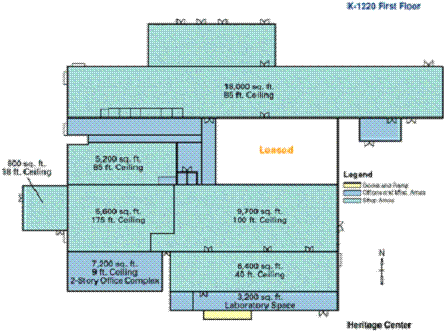
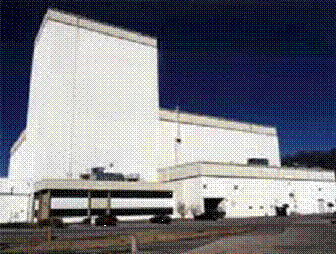
Chapter 4: K-1200 Complex
The K-1220 Complex includes K-1200, K-1200 Laydown Area, and
K-1220 as well as other facilities near these buildings. This area was a gas centrifuge
plant and storage space. We will examine those portions that are targeted for reindustrialization
and have public DOE documentation regarding contamination and safety issues.
(Please note that K-1201 is not in this complex
and will be discussed in Chapter 5.)
Contamination
K-1200
and Parking Lots
The Department of Energy proposed to lease approximately 37,250
square feet of parking area adjacent to K-1220 to Perma-Fix. Perma-Fix will use
the property for the storage of equipment and other material used in their
operations. Perma-Fix will also use the property for vehicle parking in support
of their lease of adjacent buildings, K-1200, K-1052, and K-1052-B.
The East Tennessee Technology Park�s (ETTP) Environmental
Compliance Organization (ECO) performed a review of government records and an
inspection of the property in accordance with Section 120(h) of the
Comprehensive Environmental Response, Compensation, and Liability Act (CERCLA).1 The organization performed this review to
identify any areas on the K-1200 property where hazardous substances and petroleum
products were stored for one year or more, areas where hazardous substances
were released,
or areas where hazardous substances were disposed.
ECO concluded that there was no evidence that hazardous
substances were stored in quantities above the reporting threshold of 1000
kilograms (kg) in the areas to be leased for more than one year. There was also
no evidence of releases above the reporting requirements of Resource Conservation
and Recovery Act (RCRA) regulations.
In addition, ECO reports that the area was not radiologically
contaminated and that dose rates were representative of background data at ETTP.
A visual inspection of the area identified asbestos-containing
materials in poor repair, transformers containing PCB�s, and a ladder leading to
the roof of K-798. The roof of K-798 is roped off as a radiological buffer
area. Also, radiological data was not available for all areas to be leased.
ECO assumes that radiological data for this facility will be
similar to radiological data of adjacent areas. However, ECO conducted no
additional
sampling in the area.
K-1220
In February 1995, the Tiger Team summarized data on K-1220
Centrifuge Plant Demonstration Facility at K-25. Its report states that the building
was in operation from 1981-1985 and was used primarily to test operations on
equipment designs including the P1 cascade and supporting processes (see figure
8). The report noted that waste characteristics of the building include
uranium, hydrocarbon oils, and fluorocarbon oils. However, there were no known
releases to the environment.
The report also detailed problems with the K-1220 facility. Most
notably, though it is part ofthe Decontamination and Decommissioning Program, much
of it remains classified, as do possible contaminants. The Tiger Team was
concerned with the possibility of contamination in the building interior and
equipment; however, this information is unavailable to the public. One must
also assume that contamination information is not available to the possible
occupiers of K-1220. Any cleanup is therefore also classified, so it could be difficult
for lessees to be assured their space is safe.
In 1997, the Oil, Chemical, Atomic Workers (OCAW) International
Union also studied the K-25 Centrifuge complex, which included K-1200, K-1210,
K-1220, and K-1052 as well as K-1004-J.2 They found that these buildings included �Epoxy
Resins (and dust from the resins), 4-Methylenedianiline (MDA),
m-Phenylenediamine (mPDA), bis (2, 3-Epoxycyclopentyl) ether (BECPE),
Diglycidyl Ether of Bisphenol A (DGEBA), fibers (type of fiber is classified),
alcohol, TCE, Freon, UF6, radiation, and noise. The levels of radiation and UF6 were reported as low to medium.� (Please see
Appendix B for OCAW maps indicating contaminated buildings.)
When DOE leased the front half of K-1220 to Applied
Technology Division, the Environmental Management Division (EMD) of LMES
created a CERCLA Assessment of the area. EMD did not perform any sampling in
conjunction with this assessment, yet concluded that there are no chemicals or
radiological hazards identified with the leased portions of the building other
than possible asbestos and PCB�s. In addition, all areas surrounding the leased
portions of K-1220 are considered radiologically contaminated. The Federal
Facilities Agreement between the East Tennessee Technology Park (ETTP), DOE, and
the Environmental Protection Agency (EPA) is considering possible removal
action in these areas.
As DOE prepared to lease other areas of K-1220, Bechtel Jacobs
Company produced a Baseline Environmental
Analysis Report (BEAR) in December 1998.4 The
report identified former buildings T-27/T-5 and T-7 as two potentially
contaminated areas within the K-1220 area. These buildings contained a pipe
weld shop and a paint shop.
However, no nonradiological sampling was conducted as part of
this assessment. Radiological sampling identified posted contamination areas inmuch
of the building. This report did not identify any contamination areas above the
10 CFR 835/DOE 5400.5 contamination limits in unposted areas.
Past investigations found contamination in a large portion of
the Centrifuge Cascade, Feed Station Area, Withdrawal Area, Machine Recycle Development,
and second floor Control Room� areas adjacent to the property being leased.
However, these areas are classified so no information on their safety or
contaminants is available.
Health Risks
In December 1998, Science Applications International Corporation
(SAIC) performed a Screening-Level Human
Health Risk Assessment5 at K-1220. The goal of this evaluation was to identify potential
radiological and chemical hazards for workers at K-1220. DOE contractors used
existing soil data and radiation measurements collected during past projects.
These data include surveys by the Radiological Control Organization
(RADCON) and soil sampling in support of the East Tennessee
Technology Park (ETTP) site-wide
assessment.
Radiological risks were calculated for each area sampled
including levels 1 and 3, the cascade area, and the roof. The highest
calculated risk level for an individual area within Building K-1220 was room
2E-4 on the 3rd level. The 3rd level was the only area that measured effective radiation doses
greater than background levels. Risks fromingestion and inhalation for Building
K-1220 are well below EPA�s acceptable risk range. The total
risk to a worker moving throughout the building was also below
the acceptable risk range.
Processes inside Building K-1220 were considered unlikely to
result in chemical contamination; therefore, no data was collected, and an assessment
of chemical risks was not conducted.
In a letter from Camilla Warren, Chief of DOE Remedial Section
of EPA to Margaret Wilson, Project Manager, Oak Ridge Remediation Branch (DOE)
in February 1997,6 the EPA concludes that the information provided by DOE does not
establish an adequate basis for determining the safety and protection of public
health and environment.
EPA does not concur with the
DOE�s recommendations for leasing K-1036 and K-1220.
Analysis: Is the K-1200
Complex Safe?
From a review of these documents, there are questions throughout
the complex. Radiological data was lacking for someareas of K-1200, and ECO did
not perform further tests to ensure worker safety. ECO also did not provide
details about decontamination of radioactive areas of K-1201, yet assures
workers that the building is safe. EPA does not believe that K-1220 is safe for
leasing due to classification of adjoining areas. In addition, DOE made
assumptions of risk rather than taking samples and testing to be sure. Though
DOE has leased out much of the 1200 complex, there seems to be insufficient evidence
to assure current workers that these areas are safe.
Notes
1 Environmental Compliance Organization,
Comprehensive
Environmental Response, Compensation, and Liability Act


